
Decide
Repair or Replace Your Concrete Driveway?
A straight decision framework based on crack width, movement, spalling depth and age, including the case where the right answer is a trade we do not do.
We pour and replace concrete, so you should read what follows knowing which way our interest points. That is exactly why the first thing worth saying is this: a good number of the driveways we are called out to look at do not need replacing, and some of them do not need us at all. What you actually want is a way to tell which category yours is in before anyone quotes you.
Start with one question: is it the surface or the base?
Almost every driveway decision reduces to this. Concrete is strong in compression and weak in tension, and it is only as good as what it is sitting on. If the slab is intact and supported and the problem is on top, that is a repair. If the ground underneath has failed, or the slab has cracked through in multiple places, the surface is a symptom and patching it is spending money on the wrong layer.
Everything below is a way of answering that question from your driveway.
The five signals
1. Crack width and displacement
Hairline cracks are normal. Concrete cracks; the craft is deciding where, which is what control joints are for. What matters is width and whether the two sides have moved relative to each other. A crack you can lay a credit card into that is flush on both sides is usually stable. A crack wider than about a quarter inch where one side sits higher than the other means something below is moving, and that is not a surface problem.
2. Does it move?
Stand on the edge of a suspect section while someone drives a car slowly onto it, or watch it as you walk across. If a panel rocks, tips, or you can feel it deflect, the base under it is gone or washing out. No amount of crack filler addresses a void.
3. Spalling depth and spread
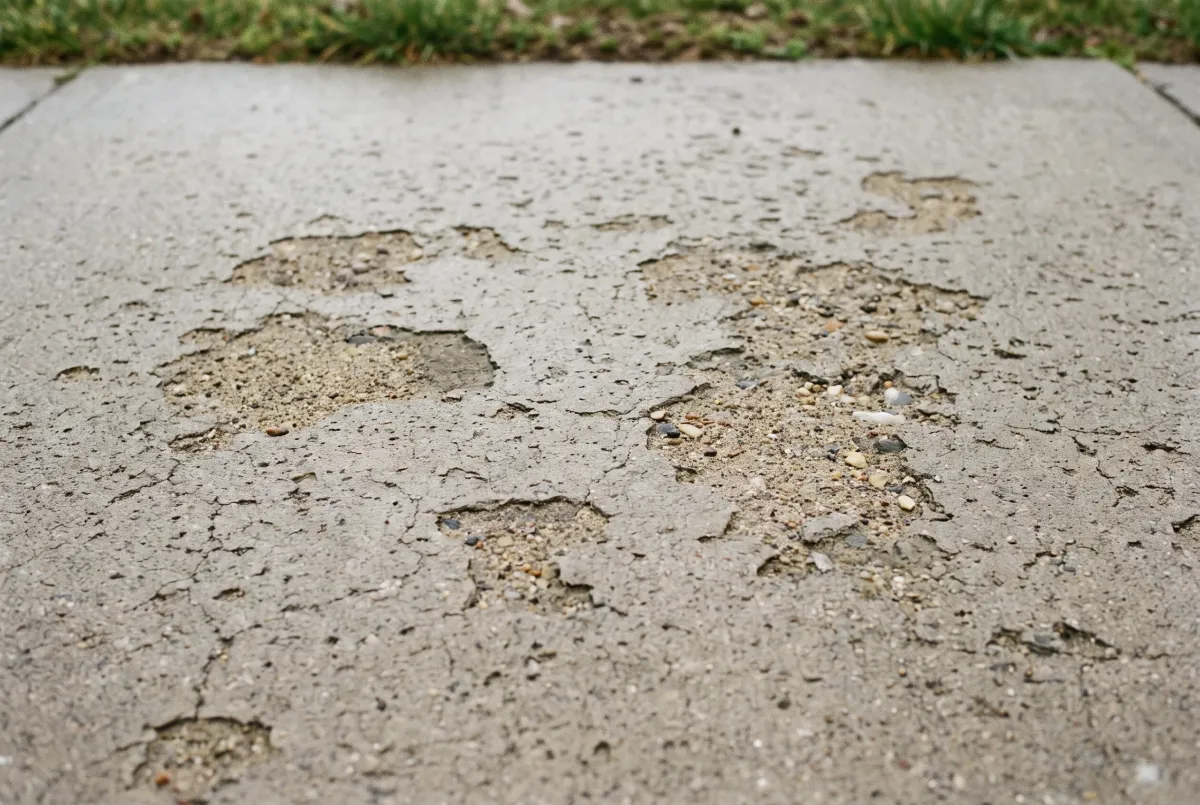
Surface scaling, where the top few millimetres flake off, is usually a freeze-thaw and deicer problem. If it is confined to one area near the street or the garage apron, that is repairable. If it is across the whole driveway and deep enough to expose the aggregate, the surface paste has lost the fight and resurfacing over it will fail on the same schedule.
4. How many panels
One bad panel in an otherwise good driveway is a panel replacement, and that is a real option most people do not know exists. Cracking across most of the panels is a slab-wide or base-wide condition.
5. Age
A properly built driveway here should give you decades, and age on its own decides nothing. What age does is change the question you ask. Under about fifteen years, look hard for a specific cause before replacing, because something went wrong early and it may well be fixable. On an older driveway, the same symptoms are more likely to be the slab reaching the end of its service life rather than a fault you can chase. Treat that as a prompt to look closer at the other four signals, not as a cutoff.
If it has simply sunk, you do not need us
This is the honest bit. If your driveway is in sound condition and has settled, dropped at a corner, or created a lip at the garage or the sidewalk, the right answer is very likely slab lifting rather than replacement. Mudjacking and polyurethane foam raising put the slab back where it belongs at a fraction of what a new pour costs.
That is a different trade with different equipment and it is not what we do. We pour and replace. If a lifting contractor can solve your problem, hire the lifting contractor, and we would rather tell you that now than after you have paid us to break out a perfectly good slab.
Where lifting stops working is when the concrete itself has failed. Lifting a slab that is already cracked into pieces gives you the same broken slab at a better elevation, and the cracks usually open further in the process. Sound concrete in the wrong place is a lifting job. Bad concrete in the right place is ours.
The ten-year arithmetic
The comparison people make is this spring's patch against this spring's replacement, and patching wins every time on that framing. The comparison worth making is the decade. It is the same lens that settles the concrete against asphalt question, where the material with the higher day-one number is usually the cheaper one by year fifteen.
Patching a symptom whose cause is a failing base does not stop the cause. The patch holds, the slab keeps moving, a new crack opens next to it, and the freeze-thaw cycle works on the fresh edges you just created. Two or three rounds of that, plus the sealing and the disruption each time, and a lot of homeowners find they have spent replacement money in instalments and still have a patched driveway.
We are not going to put fabricated figures on that here, because the honest version depends on your slab. But when you get a repair quote, ask the contractor what is causing the failure and what happens in three years if the cause is not addressed. The answer tells you which column the job belongs in.
Why driveways fail early around here
Three causes account for most of it, and all three are local.
Deicers in the first winter. New concrete is saturated and at its weakest, below the 3,500 psi threshold at which it can survive freeze-thaw while saturated. What deicers actually do is hold more water at the surface and force it through additional freezing and thawing than it would otherwise experience. The standard recommendation to swap in magnesium or calcium chloride is simply mistaken. The regional ready mix association puts both on its never-use list, and Oregon DOT testing across the chlorides showed magnesium doing the most damage to compressive strength. Grit, always, and absolutely nothing during winter one.
Thin pours and missing base. Four inches is the residential minimum, and Gurnee requires it. Under it you want four inches of compacted granular base. A driveway poured at three and a half on unprepared ground will look identical for two years and then tell you the truth.
A joint plan that was doomed from the start. Spacing wants to sit between twenty-four and thirty-six multiples of the pour depth - call it ten feet on four inch concrete, fifteen at the absolute outside - with the blade going a quarter of the way down and never under an inch. Space them wider or cut them shallower and the slab decides for itself where to break.
Something else worth having straight: steel in a slab is not crack prevention. What mesh does is restrain how far a crack can spread apart once it forms. Useful, but a narrower promise than the one usually made across a kitchen table.
If you are replacing, the apron is its own project
The strip between the sidewalk and the street sits in the public right-of-way, and in Gurnee that means a permit for any work including a straight replacement. The contractor needs a $10,000 license and permit bond, $1M/$2M general liability and $500,000 workers compensation on file. A homeowner doing it themselves posts a $100 refundable bond. Budget five to ten working days for the permit and expect two inspections.
Two practical notes. Apron thickness is set by the municipal specification, not by the four inch residential default, and it varies by town. And a contractor who does not raise the permit unprompted either is not pulling one or has not done work here. The full sequence, application through second inspection, is on our driveway apron permit walkthrough.
So which is it?
Sound slab, localised problem, still young: repair, and get a specific cause. Sound slab that has sunk: call a lifting contractor, not us. Multiple cracked panels, movement under load, or deep spalling across the surface: you are replacing, and the question is when rather than whether.
If that lands on replacement, a concrete driveway replacement is the core of what we do across Gurnee, Waukegan, Grayslake and the rest of Lake County. The estimate is free and it happens on your driveway, and the four costs replacement adds over a fresh pour is the page to read before that visit.
Not sure which one you are looking at?
Four quick questions and a local concrete contractor will be in touch to set up a free on-site estimate. If it turns out you need lifting rather than replacement, we will tell you that.
Sources
- National Ready Mixed Concrete Association - CIP 2 scaling, CIP 6 joints and reinforcement, CIP 27 cold weather.
- Wisconsin Ready Mixed Concrete Association - deicer guidance and regional flatwork practice.
- Village of Gurnee - driveway permit, contractor bond and insurance requirements.
- American Concrete Institute - ACI 306R-16 cold weather concreting.
Get My Free Estimate
Get your free, on-site estimate.
Tell us about your project and we'll call you back the same day to set up a free measure and price.